Saturday, November 27, 2010

This is Not a Portrait


My guide drawing.


Some months back I was asked by my friend James Esber to participate in a project to be included in his solo show that opened last week at Pierogi Gallery; my assignment was to make a drawing based on one of his, part of a series of portraits he’d done derived from an iconic photograph of Osama bin Laden. Now completed, my drawing--along with 99 others--hang together as part of a work entitled This is not a portrait.


James and I have known one another for a good thirty years, having met at art school in our hometown of Cleveland. The rigorous, sometimes stodgy program there was--until recently--the only five-year BFA program in the country, with its industrial design program attracting recruiters each year from the Big Three automakers; we “real artists” were on our own.


Though I hadn’t drawn seriously for some time, reasons abounded to put hesitation aside and do it: for one, it offered another glimpse into his creative process, continuing on from the interview I’d conducted two years ago with James and his long-time partner (and fellow painter) Jane Fine for The Brooklyn Rail just prior to their first collaborative show.


The project too bridged my artistic origins (I started out as a painter) to current interests in collaborative and constraint-based processes; the distance between certain suppositions contained in each, though, was what really intrigued me the most.


For the last several years, James has derived inspiration from images ranging (in his words) “from the violent to the saccharine”; he salvages scraps from photojournalism, caricature, kitsch figurines, the Bureau of Printing and Engraving, the marginalia of Don Martin (of MAD Magazine fame), and other picture-making traditions light years away from museum decorum. The ability of these images to survive his radical transformations is testament both to his draftsmanly skills and the deep imprint of their source materials upon our psyches.


Layered too within the work is a long-standing fascination with anamorphosis and other types of distortion. There’s a spatial elasticity that varies from one work to the next, but that never fails to astonish. The bin Laden drawing from which I worked is typical: as much as likeness is retained, the movement of its lines is cutting, playful, and free. A face we know so well from page and screen is nonetheless prone to deformation. The left side of the face and the right eye appear pulled by opposing gravities, while hair, beard and headscarf cascade joyously toward the bottom of the page.

During breaks in the course of drawing I paused to make some notes; they’re the basis for the following, grammatically repaired and made a bit more cohesive after the fact.


***********


- First things: wipe down table, and wash hands to protect the masterwork-in-waiting from bodily oils and the embarrassing smudges they make. Inside the supply pack he’s given me are bottles of brown and black ink, a little welled palette, and a much better sable brush than the ratty ones I’ve used in the past. A software upgrade or a case of blank tapes can never compare to such implements (or, more than anything, paint), whose sensuality I now realize I miss.


- The enclosed guidelines state that:


The drawings will be made on a translucent piece of parchment with a copy of the original drawing underneath to serve as a guide. However, I am not asking people to make an exact copy of my drawing. It is more accurate to say I am asking them to overlay each line of my drawing with their own line.


And the last paragraph:


An 8 1/2” x 11” reproduction of my original drawing is included as a second guide. You may or may not wish to refer to it. I am estimating the drawing will take between two and five hours to make. I want it to be an enjoyable process, so if it appears to be taking longer than this, you are probably being too precise or too cautious.


- All set up, ready to go- now to match the grace and agility of his line and add my own.


- First hour is spent just trying to get my bearings; while relieved of the challenge of gauging proportions by the guide drawing underneath, it turns out the parchment is more opaque than I’d expected. I struggle to see more than the basic location of marks- their subtle articulation is pretty much obscured. Moving across the surface, looking for a foothold to dig into- a few strokes here, a bit over there; hopefully it’ll add up to something.


- Never really got the hang of brush and ink either- the first-try accuracy was never my forte. No corrections! I refuse the loophole allowed in the instructions:


A small container of white gesso is provided in case you make a mistake so glaring that you need to correct it. Simply use the gesso like White-out to overpaint the area and then redraw the lines on top after it dries.


Now I’m wavering... maybe I’ll allow myself a second go-round with the gesso just to clarify a few passages. But then where does it end? What’s to stop me from correcting the corrections? This is where neurosis kicks in.


- Speed seems vital to mastering this, at odds with the plodding line I’m laying down.


- Getting into a rhythm now. Or maybe its just the spaces between my many attempts at a beginning are now filling in? Silencing the critical voice seems to help things flow.


- de Kooning envy reappears (how long since I felt that?), of that extraordinary facility (innate?) honed beyond the human by his years painting signs. Drawing with his eyes closed, along with those made while watching TV (and with whiskey as a constant companion) were some of the methods used to stymie that facility and keep himself interested.


- Ballpoint pen is the tool for me, more forgiving the way it allows the hand to keep moving and absorb the angst that comes with the desire to make the right strike in the right place.


- Some marks describe; others delineate or direct; often a single line performs more than one function. Above and below the right eye are a series of hashtag-ish flourishes- more than any others, they shirk their depictive role and assert a mark-for-marks-sake autonomy. The right side of the beard features a serpentine swoop that’d make a nice water park attraction. Watch out though- you’re liable to land in what looks like a gnarly heap of intestines.


- Esber envy joins that of de Kooning. James’s grace is astounding- he’s incapable of making an ugly mark. Surprised too by the competitive impulses aroused going into this. Imagine, me trying to improve on this work. Thinking back to school, I recall a competitive spirit, if you could call it that- more like a challenge by example.


- Funny to realize that the act of drawing may bring me the closest I ever get to a meditative state. To draw is to paddle against the current of shortening attention span, a slow triangulation between eye, object, and image.


- At it for a few hours now- time to take a break.


- The short break I meant to take turned in to two days- now on to round two. Surprised at how much there is still to do.


- Is a drawing of a drawing still a drawing? It seems closer to what tattoo artists do. I waver between my attempts at seeing through the heavy vellum parchment well enough to make a proper tracing and, seeing the futility of that, looking to the scaled-down print-out I’ve been given for guidance and clearer direction. I think about the different types of mimicry performed when serving self-directed creative apprenticeship- copying hot rods out of magazines into a spiral notebook, figuring out the chords to Iron Man.


- In certain places, it’s hard to know where beard ends and headscarf begins. Does it matter, really? Maybe just as a place marker- away from easier facial features, the less recognizable passages are places I get lost. I notice I’m resorting to language as an aid to memory, as naming assists in the transfer at that moment my eyes move from the smaller reproduction to the surface of my drawing.


- Esber is a sadist! How else to explain this project, with these parameters, following this drawing? Trying to make sense of the virtuosity underneath against this mess I’ve made on top. The tangled eyebrows are especially challenging- I decide to simply go my own way. And the lower half- a place to get lost, an interminable Tora Bora. This is the first time the subject of the drawing has really even crossed my mind.


I am estimating the drawing will take between two and five hours to make. I want it to be an enjoyable process, so if it appears to be taking longer than this, you are probably being too precise or too cautious.


- I’m coming close to the finish now, somewhere into the seventh hour. Too precise, but not precise enough. Too cautious? Maybe so. It has its moments though. It’ll look best hanging high on the wall, and not directly next to his.


Other drawings hanging in James's studio.

Friday, August 13, 2010

"On a Phantom Limb" by Nancy Andrews


Nancy Andrews- Ghosts- drawing, 2008


Here is an essay entitled Contemplating One's Own Skeleton, which I wrote for the DVD release of On a Phantom Limb, a 2009 film by Nancy Andrews; the film will have its New York City premiere on September 23 at Anthology Film Archives, along with her just-completed film, Behind the Eyes Are the Ears and Dave Fleischer's Snow White. This is a don't-miss program- I hope to see you all there.

http://www.nancyandrews.net/
http://anthologyfilmarchives.org/


* * * * * * * * * *

There were things I could draw pictures of,
and there were things that couldn’t be drawn;
more and more I was attracted to the second category.
There were things I wanted to describe, but I didn’t know how.
There were things that I wanted to show, but there was no way to show them.

from The Haunted Camera by Nancy Andrews


Let’s begin with these words, voiced by one Ima Plume, and zero in on a key tension at play within the films of Nancy Andrews. For now, we’ll ignore the failure those words imply and turn instead to her pursuit of the unknown, the invisible, the what-lies-beyond, qualities that impel her larger creative project.

Her most recent film, On a Phantom Limb, looks far beyond the visible. But what might this mean, given the extensions available to our senses by way of technology? Viewing the contents of a sealed handbag at a security checkpoint, remote locales mapped by hi-res aerial photos, or an exploding star via radio telescope, we are shadowed by an omniscience once linked to God and the novel, blasé toward a shrinking frontier.

Long drawn to the unfathomable and the unaccounted-for, Andrews considers what our technological apparatus hasn’t mastered and cannot access. In her film entitled The Dreamless Sleep, she paid tribute to Else Bostelmann, a forgotten illustrator who drew—sight unseen—the sea creatures described via telephone connection by the early underwater explorer William Beebe during his pioneering descents in a bathysphere. Surely her interest in Bostelmann stemmed as much from the excitement of Beebe’s discoveries as from the fact that these images weren’t photographed, but imaginatively interpreted by way of drawing, under circumstances much like a stenographer receiving dictation.

Late in 2005, illness brought Andrews face-to-face with the what-lies-beyond; On a Phantom Limb depicts that moment with the simple shock of black paper ripped away to reveal the words, I thought I’d died scrawled beneath, a gesture recalling a pain that signaled something was dreadfully wrong. Flown by helicopter for emergency surgery some 200 miles away, she was held while doctors waited for her condition to stabilize before operating; it never did. Her body temperature was then lowered precipitously, inducing temporary cessation of heartbeat, breathing, and brain function so the surgery on which her life depended could then be performed. Several days later, another operation was necessary to address complications that arose with the first; following that, her slow recovery began. Under heavy sedation, suffering intense hallucinations and delirious for weeks on end, the shock of such extensive bodily and emotional trauma left its lasting mark.


Nancy Andrews- Hospital Bed- drawing, 2008


Andre Bazin once asserted that, “If the plastic arts were put under psychoanalysis, the practice of embalming the dead might turn out to be a fundamental factor in their creation. ...[P]roviding a defense against the passage of time...satisfied a basic psychological need in man...to snatch it from the flow of time, to stow it away neatly, so to speak, in the hold of life.” For Bazin, this impulse to preserve—traceable at least as far back as the mummies of ancient Egypt—reached its zenith with the development of photography (and by extension, cinema); further on, he likened the medium’s indexical nature to that of a death mask. Andrews, having spent weeks perilously close to death, essentially assigned herself the task of evoking the fear and vivid sensations forever inscribed in both muscle and mind. To report one’s subjective state by way of a medium whose objectivity is its strength: how might Bazin’s formulation apply to a film that represents life prevailing—albeit temporarily—over death itself?

Midway into On a Phantom Limb, a series of closeups follow the trail left from the surgeon’s scalpel across the filmmaker’s body: a scar running from the shoulder blade, down and around the rib cage, and extending below the navel. In the words of her internist, “...this gets you about as deep into a human body as you can get”, offering not just visceral evidence of trauma, but an affirmation too of the power of cinematic realism as claimed by Bazin.

The scar, though, has a dual nature: we follow its serpentine course, yet it indicates nothing of the drifting twilight of days in intensive care or the emotional suffering and paranoia that colored them, much less a framework to help make sense of all that happened; it is both explicit narrative and shut-up secret. To the extent that those secrets are revealed, it must occur by other means.

The sequence which follows inverts what precedes it: using WWII-era archival footage of a workshop for prosthetic limbs, the contours of new body parts are traced out on flat sheets of plastic, echoing the line of the scar traversing her trunk much in the way that a flat map projection relates to a globe. But there’s something more here, beyond a simple rhyming of forms; we’re asked too to consider the nature of prosthetic augmentation- of inert, foreign materials joined to the living continuum of one’s body. Along with that, there is material that Andrews herself created: a woman plotting out the contours of a large head of a bird and beginning its construction, shot to match the archival scenes. The critic Gilberto Perez once described the crosscutting of D.W. Griffith as “a rupture looking forward to its mending”; these words recall both the bodily repair depicted within On a Phantom Limb and the grafting together of seemingly incongruous discourses, cinematic and cosmological.

On a Phantom Limb has little to do with the laws of narrative gravity as defined by Griffith and others. The film as a whole is (as with her previous work) a stylistic and discursive hybrid, a montage of attractions; live action, archival material, puppets, and various types of drawn animation are combined in sometimes tenuous ways, summoned by outright necessity. But what, for our purposes, lies beyond the visible, and how can it be accessed?


Nancy Andrews- Study for Future Film Birds and Hands- drawing


For Andrews, Mircea Eliade’s Shamanism was crucial in the film’s conception and in bringing us closer to a sense of emotional truth. Surveying shamanic initiation rituals the world over, Eliade identified several of its aspects common from one culture to the next: sickness and delirium; symbolic death of the neophyte; ritual dismemberment of the body; renewal of the organs; resurrection. Within these recurring threads, the filmmaker recognized uncanny parallels to her own encounter with death, as well as an imaginative framework for reconsidering that experience through the medium of film.

On a Phantom Limb hovers in an indeterminate zone, less a place than a state of consciousness. The avian imagery seen throughout is part of this- even more than in her previous films, where birds are quite prominent. In shamanic lore, birds often act as go-betweens moving from Earth to heavens to underworld; the film itself functions in much the same manner.

A biform creature—part bird, part woman—appears as both drawing and in live action - posing heroically, flying a kite (modeled after herself), and rocking out with guitar and drums in a giddy musical interlude. The costume from the workshop sequence—much like the shaman’s costumes described by Eliade—is donned by the filmmaker herself, complete with a superhero’s cape. Elsewhere, that body is reassembled limb by limb by a large raptor, itself augmented with mechanical parts- a tutelary spirit perhaps, and clearly an allusion to lived experience.

Reading Eliade and the varying accounts of shamanic practices, one can’t help but wonder what to make of the dissonance in recall between initiate and profane witness. On a Phantom Limb recasts this dissonance, turning the mortal encounter of another inside out, and creating a means through which to imagine what we will inevitably face ourselves.

Monday, August 2, 2010

Rammellzee 1960 - 2010


Evolution Griller the Master Killer, Gothic Futurist, #1 Stain On The Train: these and other monikers belonged to Rammellzee, whose passing on June 27 marked a rupture in the Afro-futuristic continuum joining the likes of Sun Ra, Drexciya, and Anthony Braxton. Too little known outside the circles of graffiti and Hip Hop cognoscenti, I first learned of his existence back in 1983 when he was invited by Francesco Clemente to Skowhegan (of all places) to speak about his work. Far beyond my ability to summarize, let’s just say he blew many minds that day, and confirmed the sneaking suspicion that my provincial, Bauhaus-derived art schooling was leaving me ill-equipped for the slippery but very real issues at stake; what follows is a modest attempt to come to grips with that unforgettable summer afternoon.

For me and the legions of MFAs saddled with student loan payments to last their lifetimes, it was galling to encounter the kind of effortless originality that Rammellzee embodied; in 1997 he told Peter Shapiro that he believed himself to be a “real monk from the 14th century. I know too much, put it this way. There’s no possible way that, if I didn’t go to school, I’m going to know all this shit, since I don’t read and I only look at that [he points to a dictionary], and that’s not a book you read.”

Rammellzee won early notoriety in the late 70s as a scourge of New York City law enforcement, trespassing through MTA train yards, tagging trains from top to bottom- in color, courtesy of Krylon. He saw that activity as a form of warfare, a pitched competition in which fellow bombers decided the victors. As the art world briefly tapped that talent pool (hoping to interject some “street authenticity” amidst the faux primitivism and flailing gestures of Baselitz, Chia, Basquiat, and company), Ramm was critical of old friends who succumbed to the endless flow of cash, squandering credibility with tossed-off works that paled under the track lighting of Soho and East Village galleries.

During these years he devised what he called Ikonoklast Panzerism (or alternately, Gothic Futurism). In the spirit of Sequoyah, inventor of a system of writing for his Cherokee kin extracted from shards of the English alphabet, his aim was to “armor the letter”, mounting a symbolic defense against co-optation by the art market and, in a broader sense, the culture’s tendency to deploy language as a weapon against those less powerful: “...there was another type of war, a political war of languages, where – let me say I’m not a racist, but I am racing - certain people had used language in a dominating effort to take over other languages or pictograms, and now there is a problem in schools where African languages are not allowed...”


Sequoyah- lithograph from a painting by Charles Bird King


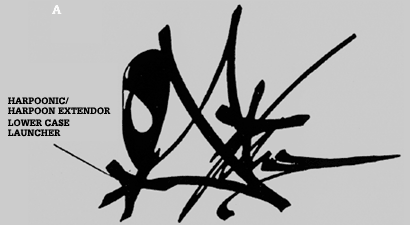
Ramm was Kabbalistic in his belief that the alphabet itself was encoded with layers of significance all but obscured through the debasement of its everyday use. The ideas contained in that subway handiwork (now long gone, as are the trains it covered) were later laid out in his Ionic Treatise Gothic Futurism Assassin Knowledges of Remanipulated Square Point’s, as grammatically freewheeling as the title suggests. Its language is not so much written as sculpted, an accretion of science, mysticism, neologisms, and puns; its voice is oracular, and not a little paranoid. Here’s what he said about the letter A:

Capitol energy houser constructor (finance) formation high bar strategy middle lane missile launcher uppercase falls once. Second case, second case second lane missile launcher falls twice, third lane vortex complete, all lanes hold complete. Full knowledge complete ∆ (Pyramid) formation final beginning knowledge of the O (cipher and square).

Rammellzee- illustration from Ionic Treatise Gothic Futurism Assassin Knowledges of Remanipulated Square Point’s


Last year I introduced the Ionic Treatise to my Writing and Practice class at Brooklyn College alongside Henri Michaux’s Stroke by Stroke, fitting by virtue of a shared distrust of language, and through the ways their drawing and writing worked in relay with one another. A passage toward the end of Michaux’s book—from a piece entitled Of Languages and Writing: Why the Urge to Turn from Them—would surely have met with Ramm’s approval:


Applied languages, directed languages, organizational tools.

A business enterprise now, language, unbeknownst to anybody, takes the place of murmurs, laments (faint or clear), calls. Commanding, commandeering.

Destined to become an ADMINISTRATION into which every conscience must enter.

Master of the situation, language will answer every need (!). Like tyrannies.

The handcuffs of words are on for good.

Henri Michaux- Untitled (Mouvements) 1950 -51


Aligned as their attitudes might have been, key differences in the conclusions they drew came through in how they handled their materials. Through the fluidity of ink and brush, Michaux’s hand fought the letter and all it signified. Drawing back toward a liquid state, to the letter’s prehistory as pictogram- this was passive resistance in graphic form. Rammellzee played the warrior, ready to reclaim and defend; his letters appeared as a bulwark, impermeable hardness rendered with a mist of aerosol.

The militarized imagery ran through Ramm’s later work as well- in the Letter Racers (a personalized variant of Ed “Big Daddy” Roth’s Monster Model Kits), in the samurai-inspired body armor fashioned from neighborhood detritus, and in Alpha’s Bet, the dystopian screenplay for a never-realized film (though a short animated version was produced by Celia Bulwinkel.)

Sadly, this work has been ignored by New York museums (save for a couple of group show appearances); will some city institution—the New Museum, the Whitney, the Studio Museum, MoMA—at last wake up to one of its own?

Wednesday, June 23, 2010

The 7th Orphan Film Symposium


The word “orphan” typically evokes pity for the unfortunate and unloved; when it comes to orphan films though, there’s no lack of love, as was evident at the Seventh Orphans Film Symposium held in April at the SVA Theatre in New York City. Founded by Dan Streible and colleagues from the University of South Carolina in 1999, the Symposium embraces nearly any moving image produced outside the entertainment-industrial complex, attracting Méliès experts, decaying nitrate fetishists, and home movie buffs sharing tales of close calls with customs officials, rusty film cans discovered in sweltering sheds, and heroic restoration of works written off as lost long ago.

Game shows from the Sandinista regime, footage shot by Danny Williams of an early Velvet Underground rehearsal, Henri Cartier-Bresson’s first film, produced to raise funds for the Lincoln Brigade, and a lysergic collaboration by Pat O’Neill, Chick Strand and Neon Park commissioned by Sears as an in-store promotion for a new line of jeans: those were just a few of the many highlights this time around. In some instances the story of a film’s discovery could be more compelling than the film itself; throughout it all, the detective’s instincts prevailed.

Passionate belief in preservation sprung up from the podium and in casual conversation, whether explicitly addressed, or implicit in the presence of so many intelligent people pursuing this less-than-lucrative path. A basic question arose again and again: what constitutes an archive? Precipitated not so much by theoretical inquiry than more practical concerns, film archives are all too often defined by a lack of material resources, in some instances consisting of little more than a single individual’s desire to save a few odd reels.

The acquisition of the entire Twitter archive by the Library of Congress, announced that same week (a Borgesian nightmare if there ever was one), only served to remind us of—in contrast to the digital world—the material obstacles of film preservation; the Symposium was a veritable survey of the ways in which a film could disappear. Most often it happened through simple neglect of some form or another; too often though, its destruction was intentional.

It’s astounding that film and video could be valued more as raw material than for what it recorded- recycled for its silver, rerecorded upon to avoid purchase of new tape stock, or otherwise destroyed. In Standard Gauge—not included on the bill, but as persuasive a case for the Symposium’s existence as you’ll ever see (and a great film to boot)—Morgan Fisher describes watching Technicolor lab employees hack old release prints to pieces with meat cleavers. Through that act of mutilation we can glimpse, conversely, a tacit admission of value. And if this was the way the studios treated film (or as the business side of media archives refers to their holdings, “assets”), one can only imagine the many paths to oblivion for the moving image produced outside of Hollywood.

So if the notion of posterity has been antithetical to the moving image for much of its history, it was all the more surprising to see something like The Janitor, which opened the proceedings (I’m too weak to resist) with a bang. Possessing a certain raunchy splendor, this early stag film produced circa 1930 (with superb piano accompaniment by Ed Pastorini), is one of the rare works from the Kinsey Institute’s archives to be screened publicly; its illicit nature is in fact what saved it from disappearing altogether.

With The Investigators, the archive functioned again as a repository for secrets (though for very different reasons). Presented by Charles Musser, this remarkable 1948 lampoon of the HUAC Hearings suggests a collaboration between Dr. Seuss and Bertolt Brecht. Unseen since its completion, the Union Films collective responsible for its production (with Abel Meeropol, Max Glandbard, and Carl Marzani among its principals) realized that to screen it publicly would mean a sure spot on the blacklist. Herschel Bernardi, playing the Chief Investigator (and who appeared 28 years later in The Front), gives a fabulous performance; his interrogation, joined by two actresses (excellent as well, but sadly uncredited), infuse the proceedings with an undeniable energy- part cinema, part theater, all unapologetic agitprop.


Orson Welles’ Sketch Book, Episode 4, Part 2

Orson Welles’ Sketch Book, presented by Stefan Drößler, offered defiance of the state in an altogether different form. Produced in 1955 as a series for the BBC but sadly lasting just six episodes, Sketch Book proved once again (as if it were necessary) that storytelling was second nature for Welles. Here, he’s alone, addressing the camera directly, with occasional cutaways to the drawings he’s making to illustrate the story. In the episode screened at Orphans (filmed a day after his fortieth birthday, and the day before his third marriage), Welles offers an extended riff on the erosion of privacy and the rise of state surveillance by way of a rather funny anecdote in which he claimed to border agents that he was carrying in his bag a small atomic bomb. Behind the antagonism towards these petty bureaucrats was his ever-present mischief, undiminished from the days of his infamous The War of the Worlds broadcast.

Perhaps my favorite presentation was Thomas Elsaesser’s Islands of Media-Memory and Natural Remains: Pathways to a Berlin Cine-Chronicle. Natalia Fidelholtz of Storycorps (who’d initially reviewed and catalogued this material), began by presenting what seemed like little more than documentation of a cozy bourgeois idyll from the 1940s- charming yet not so unusual, save for the color stock on which it was shot.

Elsaesser then took to the podium, revealing that these were home movies of his family, shot on an island in Berlin proper during the Second World War; knowing this, the footage appeared in an altogether different light. There was little if any indication of the hardship or fear one would assume visible during that time; the period documented in the films was in fact one of courtship for his parents- Elsaesser himself was born in 1943.

Photograph courtesy of Thomas Elsaesser

Proceeding with further backstory, he recounted memories of his architect grandfather Martin Elsaesser and other family friends who appear before the camera. Unusual amongst those contemporaries unaffiliated with the Party for his decision to stay in Germany, the Nazi years were for the elder Elsaesser an internal exile, fallow in terms of commissions but creatively productive nonetheless.

It was fun to see one of the greatest of film historians incorporate Wikipedia screen grabs into his PowerPoint presentation, and fascinating to contemplate the emotional resonance of this footage for Elsaesser, gazing at his own prehistory. Given his tremendous contribution toward our understanding of the New German Cinema, there’s a beauty in locating a fragment of the real history from which it arose. And to follow the notion of familial origins that the term “orphan” implies, Berlin Cine-Chronicle reconnects an island of apparent (if not actual) bliss to the mainland of calamitous history.

Wednesday, February 3, 2010

"Genre Collage" by People Like Us

Still courtesy of People Like Us

In the current issue of Film Comment, I've written about a new work by Vicki Bennett, aka People Like Us, entitled Genre Collage. For those who know her previous video work, Genre Collage is a bit of a departure in a couple of ways: less compositing, with a greater reliance on straight cutting; the source footage is derived from narrative features, as opposed to the industrial and educational material that was typical of her past work. She's currently touring the world with it (it includes a live music component she performs on site), and New Yorkers will have a chance to see it on April 14 at Issue Project Room. Please have a look- the article can be found here:

http://www.filmlinc.com/fcm/jf10/peoplelikeus.htm

Thursday, December 31, 2009

The Magnificent Seventeen


Still from I Fidanzati by Ermanno Olmi

In an early episode of Jean-Luc Godard’s Histoire(s) du Cinema, Serge Daney suggests (speaking of the series) that as a member of the New Wave generation, Godard was uniquely positioned historically to attempt such an ambitious project:

“...there are suddenly too many films to see or catch up on this heritage-turned-monster that was the history of cinema. Before the 60s you had only four or five main countries producing films but then cinema became a world-wide industry. It’s impossible for a young person today--short of spending 10 to 15 years watching films--to catch up on everything they haven’t seen whilst also establishing an axis on which to situate their own history…”

Though I’d argue that pre-1960 cinematic history wasn’t quite as contained as Daney would have it, his characterization of the present is right on the money. This rings especially true as 2009 comes to a close (and along with it, the decade); have you noticed that at times like this, people like to make lists? Film Comment magazine requested a number of my own, to be tallied and puréed into spreadsheet form along with those of dozens of other film writers, with the result being a series of master lists representing some sort of cine-critical mass- “best films of 2009”, “best films of the decade”, “best of the avant-garde”, and so on. It’s time-consuming but fun, yet I can’t help but notice how little it resembles the sum of what I actually watch, which involves not only a lot of happy wrestling with that heritage-turned-monster, but looking beyond what most people think of as “cinema.” With that in mind, here’s a list of favorites seen this year, regardless of when (or how) they were made:

1) I Fidanzati- Ermanno Olmi: Love and longing expressed through flashbacks and an exchange of letters, Olmi’s follow-up to the just-as-great Il Posto is set against the “economic miracle” of early 60s Italy; so heartfelt, and so perfectly crafted- how did he do it?


2) Joy Division’s Transmission (performed by Steel Harmony): Rolling slow through the streets of Manchester, this steel drum ensemble plays the shit out of one of the very best songs to originate from that city. Part of Jeremy Deller’s Procession, it sings with all the joyous abandon found in a New Orleans funeral parade on their way back from the cemetery. Thanks to Amy Monaghan for this.

3) A Lecture- Hollis Frampton (Anthology Film Archives 3/28/09): A recording of HF’s 1968 illumination of spectatorship and the cinematic apparatus, originally presented at Hunter College; if that wasn’t enough, it was sandwiched in between an excellent introduction by Mike Zryd, and followed by Ken Eisenstein’s brilliant presentation linking Frampton’s lecture with Jorge Luis Borges’ The Aleph.

Still from Final Thoughts: Series One by Steve Reinke

4) Final Thoughts: Series One- Steve Reinke: A compendium of short videos that hang together as a surprisingly coherent whole, Reinke forges ahead with his often funny, sometimes shocking, yet always smart associative method, despite a (facetiously?) asserted “death of the reader.” Some of us are still hangin’ on there, Steve.

5) A Divided World- Arne Sucksdorff: Synthesizing plein-air cinematography and close-ups staged in the studio, this all-but-forgotten Swedish master depicted animals struggling for survival over the course of a winter night. Reminiscent of the river scene in Night of the Hunter, this is nature film as glorious contrivance; it really shouldn’t work, but it does- magically. Big thanks to Scott MacDonald for sharing this rare print.

Still from The Masseurs and the Woman by Hiroshi Shimizu

6) The Masseurs and the Woman- Hiroshi Shimizu: A pair of blind masseurs seek work by following a seasonal itinerary between mountain and seaside resorts; along the way, their encounters with spa clientele and staff--as well as the frank treatment of daughters sold off into prostitution--are drawn with compassionate nuance. Shimizu seems to have understood something about blindness, and even more about seeing- his visual sense is truly exquisite.

7) Promised Lands- Susan Sontag: She made films too? And how! Thanks to Light Industry for resurrecting this 1974 documentary gem about the Yom Kippur War and its aftermath. While Palestinian voices are conspicuously absent, it’s somewhat mitigated by what we do hear and see, including a deeply affecting look inside an army psychiatric hospital where battle-traumatized soldiers undergo treatment.


8) White Lightning-The Fall (music video): Someone had the right idea here: great song by the Big Bopper, ripe to be the very hit that gave the world George Jones; the mighty Mark E. (Jones’s heir apparent, at least in the saloon) seems unusually sober here, unlike the cartoon lightning and lovably dopey rear-screened bikers. Chug-A-Lug, Manchester style, could be the perfect a follow-up. Why aren’t I a record producer?

9) Anita Needs Me- George Kuchar: Don’t let the very un-Kucharesque title fool you- young George, circa 1963, makes good on his promise that, “your emotions will be squeezed.” John Waters said it alright- how much longer must GK wait for that MacArthur grant?

Drawing for On a Phantom Limb by Nancy Andrews

10) On a Phantom Limb- Nancy Andrews: This film is an autobiography, as one intertitle reads; really, it’s one harrowing chapter. Live action and various forms of animation are combined for this account of a grave medical emergency in which, as the filmmaker says, I thought I’d died. Lucky for us, she didn’t, with the film as an added bonus. Andrews is absolutely one of the best filmmakers out there now, and this one is among her most powerful- stay tuned for more about it in the coming weeks.

11) Doublestream (Part II of Caspar Stracke’s Circle’s Short Circuit: Torsten Burns reedit)*: In celebration of the original version’s 10th anniversary, Stracke has initiated a new reedit, assigning each of the five sections to an individual or team (Burns, Jenn and Kevin McCoy, eteam (Hajoe Moderegger and Franziska Lamprecht), Leslie Thornton, and myself); as the project nears completion, it’s hard not to be excited, especially after viewing Burns’s contribution, a delirious homage to the DeLorean as a modern dance video. Of all his work I’ve loved over the years, this is close to the top- look for this new version in 2010.


12) Multiple Sidosis- Sid Laverents: Man With a Movie Camera, as reconceived by a former vaudeville performer/one-man band. This small-gauge tour-de-force documents its own birth, or more precisely, the song that drives it. The meticulous layering of both music and image was all done at home--with patience, with love, and with goofy humor--in a San Diego suburb. Sid lives!

13) Sweetgrass- Lucien Castaing-Taylor and Ilisa Barbash: See my post from October 14. Happy to say, Sweetgrass will have an honest-to-goodness New York theatrical run at Film Forum beginning January 6, 2010.

Still from The Earth is Young by Michael Gitlin

14) The Earth is Young- Michael Gitlin*: Back in October I was fortunate to have been asked to moderate an after-screening discussion with the filmmaker at 16 Beaver. Studying it closely after a first viewing back in the spring, I was deeply impressed by Gitlin’s risk-taking approach and the film’s ability to challenge our presuppositions and stir debate, which it did, in spades. A terrific film, and a marvelous evening all around.

15) Our Hitler: A Film From Germany- Hans-Jürgen Syberberg: This neo-Wagnerian mini-series appeared on German TV the same year we Americans watched Roots; dirty laundry on prime time, but only Syberberg had the gumption to cast his arch-villain as a ventriloquist's dummy. “Filmed theater” is one of the harshest put-downs one can toss a filmmaker’s way, but in the case of Our Hitler, it works perfectly- all 7 ½ hours.

16) Return to LH6- Ken Jacobs: Another Light Industry highlight, the Orchard Street preacher described a time when analytical projectors were a classroom fixture (and before they would become one of his primary creative tools), when the film studies discipline was still up for grabs, and how an influential pedagogy grew out of personal aesthetic concerns.

Still from Leon Morin, Priest by Jean-Pierre Melville

17) Leon Morin, Priest- Jean-Pierre Melville: An emotionally complex, sexy, and at times very funny tale of the lives of French women under Vichy rule, with Jean-Paul Belmondo playing a parish priest (yes, that's right) in an even finer performance than his justly famous turn in Breathless just months before.

Happy 2010 to all!

*-Is it immodest to list these items that I have a direct association with? In both cases, it seems dishonest not to.

Saturday, December 12, 2009

Mr. Hulot and Mr. Schaeffer*

Shortly after the release of Jacques Tati’s Mr. Hulot’s Holiday in the summer of 1953, Paris was hit with a massive strike that paralyzed municipal services, including trains moving in and out of the city. Parisians unable to leave town that August during the height of the summer season had Tati’s film as a vicarious substitute, and it seems safe to say that for some, this groundbreaking comedy was the better option.

Part slapstick, part social satire, Tati depicted in hilarious microcosm an uptight nation unable to relax. Unlike the seaside hijinks contained within Jacques Henri Lartigue’s incomparable photographs, Tati’s shoreside inn-mates are a crabby bunch, incapable of leaving their workday rhythms behind. In the words of André Bazin, we’re witness to “…a feebly whirling duration turning back on itself, like the cycle of the tides… a conventional pleasure more rigorous than office time.”

These looping rituals are underscored by Alain Romans’ infectious song of summer, emanating so playfully from every possible source, both within the story space and outside of it; this is just one aspect of a meticulously wrought sonic fabric that would become the director’s trademark. Tati inverted the usual hierarchy of cinematic sound, with noise given unprecedented importance, and human speech relegated to a subordinate role.

In the years immediately preceding the film’s release, fellow countryman Pierre Schaeffer was sounding out his own hierarchical inversion by way of a radical new approach to composition called musique concrète; here, the staves of traditional musical notation were jettisoned in favor of working directly with the sounds of the world recorded onto shellac disk and magnetic tape. These and other pioneering methods were intended to “…open music up to all sounds”, sending pitch-perfect conservatory-trained performers running in the other direction.

Some years before, as Goran Vejvoda and Rob Young have recalled, Schaeffer had engineered the radio broadcast announcing the Liberation of Paris by Allied forces. Embedded in that program of news, music, and patriotic readings were coded signals agreed upon beforehand that, in a relay of sonic joy, directed parish priests to set their carillons ringing. It’s lovely to imagine this moment—seemingly straight out of a film Tati might later make—as one the director would carry with him for many years to come. The truth though was that Tati, who in the war’s early days wrote a scenario proposing his own fantasy inversion of a Germany occupied by the French, had wisely fled Paris to the village of Sainte-Séverè the year before to avoid recruitment for “volunteer duty” in a German factory; he missed the Liberation, but managed to find a setting and inspiration for later use in his first feature, Jour de Fête.

Jean-Luc Godard once wrote of Tati that, “He sees problems where there are none and finds them.” With his drastically pared-down shooting style that some mistook as primitive, Tati, along with his onscreen envoy Mr. Hulot, together joined forces to turn the tide of habit. The radical director teaches us the rules of their new game at the same time we begin to play it. In Mr. Hulot’s Holiday, this play includes noisy ping-pong matches and a recalcitrant old car. Both Tati’s cinematic conceits and Hulot’s character were grounded in a commitment to tireless observation, and Tati’s achievement was that through the two together, their eyes and ears become ours.

In the period following his Liberation broadcast, Schaeffer experienced his own, recounting in a 1984 interview with Tim Hodgkinson that, “I was horrified by modern 12-tone music. I said to myself, ‘Maybe I can find something different… maybe salvation, liberation is possible.’ Seeing that no-one knew what to do any more with Do-Re-Mi, maybe we had to look outside of that…”

Jean-Christophe Thomas has written that musique concrète, “maintains a unique way of hesitating between poetry, literature, and sound art”; I would add that there’s a bit of cinema there as well. Sadly though, Schaeffer in the end felt as confined as his listeners by having been “born in Do-Re-Mi”, and the impossibility of “distancing oneself from the dramatic.” In later years he expressed doubt that his compositions could be rightfully considered as music: “Unfortunately it took me forty years to conclude that nothing is possible outside DoReMi… In other words, I wasted my life.”

Perhaps Schaeffer’s failure was less with the music itself than in his inability (or refusal) to embrace the dynamic mutability of musique concrete that Thomas identified as hesitation. And wasn’t it significant to have taken those crucial first steps? Better to think of it instead as an unfinished but ongoing project.

(This is an expanded version of some program notes originally written for a Pratt Film Society screening in 2005.)

A newly restored Mr. Hulot’s Holiday will be screened as part of a Jacques Tati retrospective at the Museum of Modern Art from December 18 – January 2, and at selected theaters elsewhere.